· Study management &
data collection
· Graduate Certificate
in Gerontology
· Geographic Information Systems (GIS)
· Pittsburgh Regional Economic Model (REMI)

University Center for Social & Urban Research · UCSUR
In memory of our dear colleagues Greg Six and Don Musa
We are a University of Pittsburgh research center established in 1972 to serve as a resource for researchers and educators interested in the basic and applied social and behavioral sciences.
In response to faculty interests and current domestic policy issues, the center develops interdisciplinary research programs that address regional and national policy issues. As new policy issues emerge, UCSUR is prepared to facilitate and coordinate the development of additional programs identified by interested faculty. More...
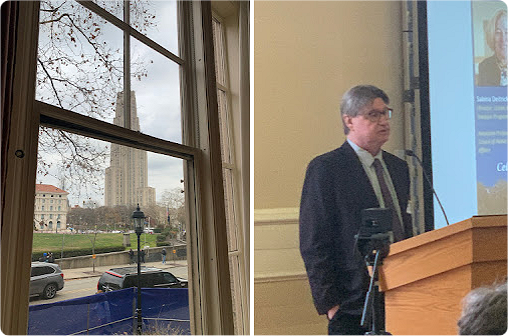
"Housing in the 21st Century: Challenges and Solutions"
412-624-5442 · ucsur@pitt.edu · @PittCSUR
Pitt Research Navigator
- Why the White House Cares About US Steel: Chris Briem of UCSURs Urban and Regional Analysis Program was interviewed on City Cast Pittsburgh: Why the White House Cares About US Steel - March 25, 2024
- Award Announcement: 2024 Steven D. Manners Research Development Awards
- News: Some states spurn migrants. The Rust Belt wants them. - Washington Post, By Tim Craig, with quotes by Chris Briem, Economist
- Report: State of Aging, Disability, & Family Caregiving in Westmorland County - Dec 2023 - By Scott Beach, PhD (UCSUR); Christopher Briem, MPA (UCSUR); Janet Schlarb, MS (UCSUR); Everette James, JD, MBA (HPI); & Meredith Hughes, JD, MBA (HPI) - Funded by the Richard King Mellon Foundation
- Article: Disentangling impacts of multiple pollutants on acute cardiovascular events in New York city: A case-crossover analysis - Jamie L. Humphrey, Ellen J. Kinnee, Lucy F. Robinson, & Jane E. Clougherty - Environmental Research
- Article: Out-of-Pocket Health Care Spending at Older Ages: Do Caregiving Arrangements Matter? - Esther M. Friedman, Scott R. Beach, & Richard Schulz - Journal of Applied Gerontology
- Report: State of Aging, Disability, & Family Caregiving in Allegheny County - Dec 2022 - By Scott Beach, PhD (UCSUR); Christopher Briem, MPA (UCSUR); Janet Schlarb, MS (UCSUR); Everette James, JD, MBA (HPI); & Meredith Hughes, JD, MBA (HPI) - Funded by the Henry L. Hillman Foundation
- Report: Pittsburgh´s Affordable Housing Crisis: Is Privatization the Solution? - Feb 2022 - By Daniel McClymonds, Jackie Smith, PhD, & Connor Chapman (University of Pittsburgh Department of Sociology) with Randall Taylor (Penn Plaza Support & Action Network)
- Research Paper: Quality of life and demographic-racial dimensions of differences in most liveable Pittsburgh - By Sabina Deitrick & Christopher Briem - Journal of Urban Regeneration and Renewal, 15 (2), 193-209 (2022)
 National Center on Family Support
In collaboration with the Health Policy Institute, UCSUR´s Gerontology Program launched the Center for Caregiving Research, Education and Policy.
 Western Pennsylvania Regional Data Center (WPRDC)
Provides an inclusive infrastructure for openly sharing civic information, and project staff members provide a range of services as a civic data intermediary.
 Geographic Information Systems (GIS)
Providing services to manage & analyze spatial data, including executing original research & providing data publishing, technical assistance, online decision support, & data education.
 Survey Research
Data Collection Services
Survey professionals, trained interviewers, and data management specialists ready to assist with your qualitative or quantitative research project.
 Qualitative Data Analysis
(QDAP)
A resource to the University community in all aspects of qualitative data collection and analysis.
 Regional Research Registry (PuRRR)
An actively maintained a local IRB-approved (PRO11060616) research registry, including caregivers. Our registry contains over 9,000 regional residents willing to take part in research studies.
 Graduate Certificate in Gerontology
Designed to serve individuals from diverse educational, employment, & professional backgrounds who are interested in acquiring basic knowledge about gerontology.
 Pittsburgh TODAY
Regional Indicators Project
In-depth journalism and regional indicators program that compares Greater Pittsburgh with 14 other regions on hundreds of measures.
 Center, Census, & Other Miscellaneous Reports
A collection of regional economic reports, census reports, annual reports, and other related compositions.
- Steven D. Manners Faculty Development Awards: These awards support pilot research in the social, behavioral, and policy sciences that has the potential of leading to larger, externally funded projects of interest to local/national foundations or state/federal agencies.
- The Pittsburgh Regional Economic Model (REMI): UCSUR uses software published by Regional Economic Models Inc. (REMI) to develop and maintain a regional economic model for Pittsburgh. Pittsburgh´s REMI model is supported by UCSUR in partnership with the Southwestern Pennsylvania Commission, which uses REMI for technology planning transportation infrastructure.
- Acquisition & Management of Secondary Data: As an affiliate of the Pennsylvania State Data Center, the official source of demographic and economic data for the state, UCSUR is a repository for electronic and printed census information, including Census 2010 data.
- Program Evaluation Services: Assisting individuals at the University of Pittsburgh and community agencies with their program evaluation needs. We provide assistance in developing and designing evaluation plans, collecting and analyzing data, and writing evaluation reports.
- Technology Services: Providing customized data management systems and services for our programs, our clients, and the community. These systems and services focus on high-level security, data integrity, reliability, performance, and functionality.
- Pittsburgh Economic Quarterly (Archives): UCSUR published the Pittsburgh Economic Quarterly (PEQ) to support organizations and staff involved with economic development throughout the region. The PEQ highlighted important economic and demographic trends that impacted the regional economy and the competitiveness of the regional economy.
3343 Forbes Ave
Pittsburgh, PA 15260
ucsur@pitt.edu · 412-624-5442